Lies, Damn Lies & Item 19 (Franchise Financial Performance Representations)
Relatively few franchise sellers blatantly provide outright false financial representations. Far more provide selective, partial, and incomplete information that is technically true, but may lead a franchise prospect to a false impression of revenue, profit margin or success.
Such subtle and often clever misdirections can easily escape detection by overworked franchise regulators, non-franchise attorneys providing cursory document reviews, or confirmation-biased franchis prospects eager to believe.
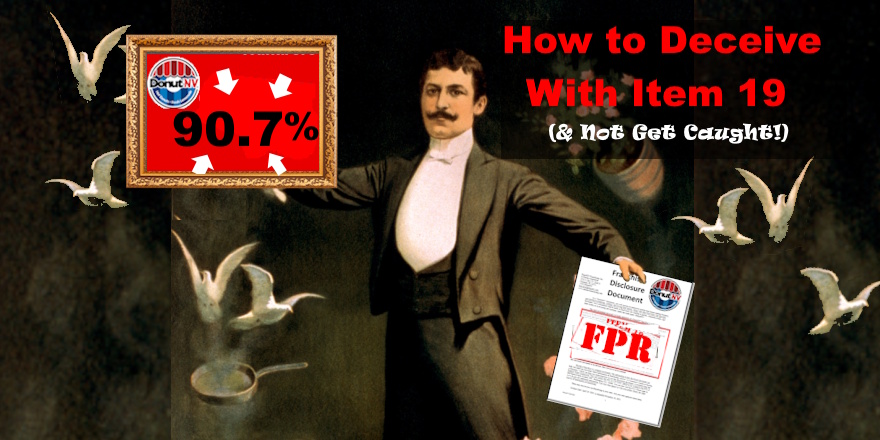
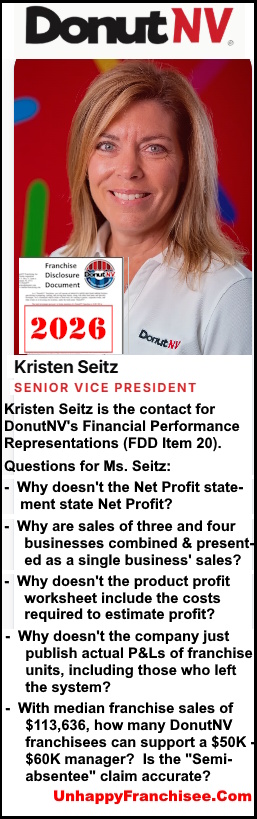
Here are three of charts in the Item 11 Financial Performance Representations section of the 2026 DonutNV Franchise Disclosure Document (FDD). Each provides a fascinating example of how underlying data, which may or may not be accurate, can be presented in a way that likely leads prospective franchisees to an inaccurate financial conclusion. The information provided in these examples is not necessarily false, and may or may not be intentionally misleading, but could likely lead to overly optimistic and dangerous expectations. Enjoy… By Sean Kelly, Founder, Franchise Truth for Veterans
(UnhappyFranchisee.Com) Here are three examples of Item 19 Financial Performance Representations that may or may not contain accurate information, but are presented in a way that is likely to mislead:
- #1. The Unrepresentative Non-Franchise Representing Potential Franchise Performance
- #2. The Net Profit Statement That Doesn’t State Net Profit
- #3. Aggregated Sales of Multiple Businesses Presented as a Single Unit’s Revenue
- #4. The Do-It-Yourself Profit Worksheet Claim That Leaves Out Costs
These are examples of how the presentation of information that may (or may not) be accurate can be presented in such a way that it could lead a prospective franchisee to an incorrect conclusion and a dangerous assumption about profitability.
What follows are my opinions and suspicions. I could be wrong. Please check the primary source documents and let me know what you think. For reference and documentation, I’ve provided the complete DonutNV 2026 Franchise Disclosure Document (FDD) registered with Wisconsin DFI, and an excerpt containing just the DonutNV Item 19 Financial Performance Representation.
Example #1: The Unrepresentative Non-Franchise Representing Potential Franchise Performance (With Disclaimers)
In the June 11, 2025 post How They Mislead With Item 19 (DonutNV Example 1), I showed how Franchise Fastlane and DonutN Franchising Inc. and their franchise brokers cherry-picked sales of a single non-representative business and presented it as representative of systemwide franchise performance:
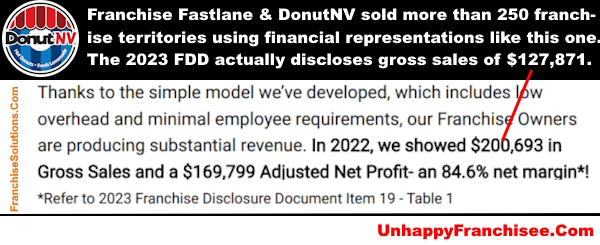

To be fair, the Item 19 section of the 2024 DonutNV Franchise Disclosure Document (FDD) did include a disclaimer stating that the non-franchise affiliate referenced in those numbers were unrepresentative of franchisee’s experience since ation no franchisee could, or would be allowed to, duplicate:
- the affiliate has NO territorial restrictions.
- The trailer had been operating since 2018 in its original market
- The trailer is not a franchise & is not under franchise restrictions
- The trailer had no territorial restrictions
- It’s operated by an experienced partner/manager
- The “Profit” figure doesn’t reflect major costs like labor, COGs, or travel expenses
Those disclaimers do not appear in the promotional ads, videos and presentations where the 84.6% profit were prominently emphasized… but at least they appeared in the DonutNV FDD.
Example #2: The Net Profit Statement That Doesn’t State Net Profit
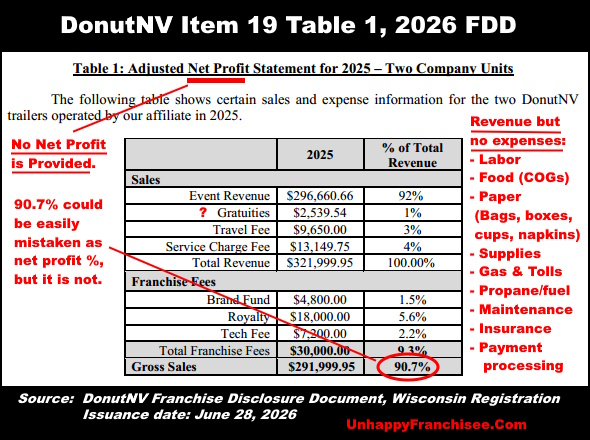
In the DonutNV Item 19, Table 1 professes to provide “Adjusted Net Profit” but does not actually deduct the ordinary operating expenses necessary to establish net profit. Such entries as Event Revenue, Gratuities* (!), and Travel Fee are included as revenue with no deduction of related expenses (like Labor, COGs, Gas & Tolls, Credit Card Fees, etc.)
The prominence of “90.7%” could easily be misconstrued as “net profit” since it appears under that heading, but it supposedly refers to gross sales.
* Incidently, keeping gratuities meant for workers violates both federal and PA labor law. If DonutNV affiliates ARE paying these gratuities to employees as required, the expense should be disclosed here to offset the revenue claim. If they are withholding gratuities meant for employees, they could be admitting to labor law violations.
Example #3: Aggregated Sales of Multiple Businesses Presented as a Single Unit’s Revenue
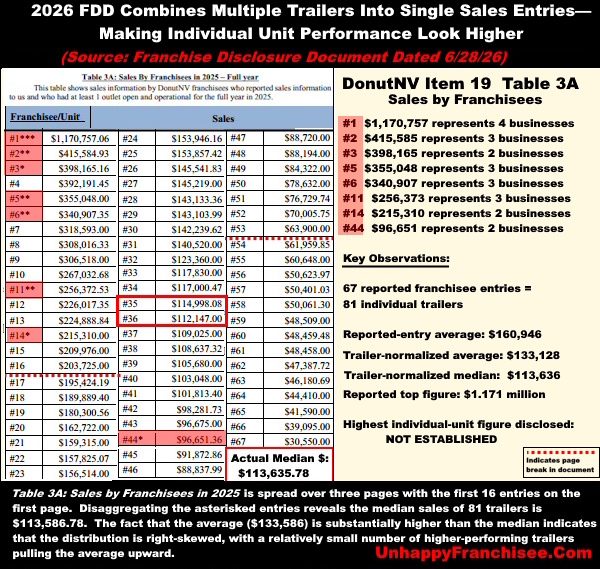
Table 3A Sales by Franchisees is definitely dressed to impress.
A prospective franchisee would definitely be impressed seeing that one franchisee is selling over $1M in mini-donuts from her DonutNV franchise, and that other top franchisees are generating sales of $415,584 and $355,048.
However, the $1,170,757.06 figure is not the sales of one DonutNV trailer. It is the combined sales of four franchised businesses.
Likewise, the $415,584.93 figure represents three businesses, and the $355,048 figure represents three businesses.
There is actually no way of determining the highest individual-unit sales from the data presented. If one computes the average of the 67 businesses included in the chart, the average sales would be $160,946. However, if one disaggregates and divides the sales evenly among the related businesses, the average of the 81 businesses is $133,128… a drop of 17%.
The unit-normalized (disaggregated) median revenue, which is not presented, is $113,636.
The fact that the media ($113,636) is significantly lower than the average ($133,128) indicates that the distribution is right-skewed, with a relatively small number of higher-performing trailers pulling the average upward.
Example #4: The Do-It-Yourself Profit Worksheet Claim Leaves Out Costs
The Federal Trade Commission (FTC) has specifically warned that financial information can be problematic when it causes a prospect to draw conclusions that the underlying information does not support. The FTC also emphasizes that a franchisor making a financial-performance representation must provide its material bases and assumptions.
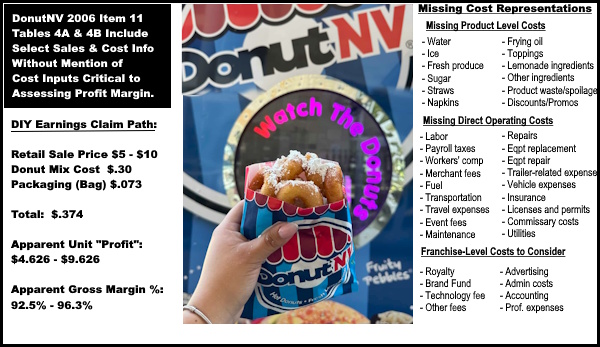
The DonutNV 2026 FDD Item 19 Tables 4A and 4B provide, in essence, a DIY profitability worksheet that very likely leads prospects to an unrealistic and inaccurate potential profit margin.
Table 4A identifies the cost and output of its proprietary donut mix, while Table 4B provides retail prices actually charged by franchisees, along with costs for packaging and certain toppings. But the tables do not provide the complete cost of producing and selling those products. The FDD itself acknowledges that additional inputs—including water, ice, fresh produce and sugar—are required.
The result is a potentially powerful confirmation-bias mechanism: a prospective franchisee can subtract a prominently disclosed raw-material cost from a prominently disclosed retail price and obtain an extraordinary gross margin, while omitting the numerous other costs required to operate the business. Nothing in the tables establishes that the resulting calculation represents gross profit, contribution margin, operating profit or net profit.
Despite Median Sales of only $113,636, DonutNV Continues to Claim it’s a Semi-Absentee Franchise Capable of Supporting a Full-Time Manager
The positioning of the DonutNV franchise opportunity as a semi-absentee business that can support the expense of a full-time manager has undoubtedly contributed to its high franchise failure rate. Ads from franchisees trying to sell their trailers and franchises regularly state that the business requires a hands-on owner-operator. While Franchise Fastlane made this a central claim of its franchisee recruitment strategy, DonutNV Franchising Inc. appears to have continued it after taking franchise sales in-house.
Promotional listings in Entrepreneur magazine, on advertising and broker websites continue to tout DonutNV as a semi-absentee and/or passive investment. Hopefully state franchise agencies and the Federal Trade Commission (FTC) will respond to the complaints and warnings about these and other potential violations of The Franchise Rule and force franchise sellers like DonutNV to provide honest and accurate disclosures needed for proper franchisee due diligence.
Full Disclosure & Author’s Note: I am writing this on Day 611 of the lawsuit DonutNV Franchising Inc. v. Sean Kelly and Relentless Inc. t/d/b/a Unhappy Franchisee. Both sides have concluded the Discovery phase and await a decision on our respective Motions for Summary Judgement. At this time, I am deep in trial prep mode in case the suit proceeds to trial. DonutNV’s persistence with this (in my humble opinion) meritless lawsuit has forced me to maintain deep and ongoing research on them, their former fso Franchise Fastlane, their advisors/investors Scott Marr, Keith Gross and Franchise Altitude, and their current franchise law firm Gross Law Group, Panama City, Florida.
My disproportionate editorial focus on this real-time cautionary tale is neither because DonutNV is the most dangerous franchise nor the most interesting subject matter I could choose. DonutNV Franchising Inc. self-selected itself as our ongoing cover story with their persistent litigation and, graciously, abundant examples of bad judgement and bad decisions that all in this industry can learn from.
Please share any information, tips or referrals via anonymous comment below or by emailing ADMIN, in confidence, at UnhappyFranchisee[at]Gmail[dot]Com.
INVITATION: All companies, organizations and individuals discussed on this website or affiliated social media pages are invited to provide corrections, clarifications, explanations, rebuttals or statements of fact or opinion which we will consider on a priority basis. You may provide immediate correction, clarification or rebuttal by posting in the comment section below, or email your statement to ADMIN at UnhappyFranchisee[at]gmail[dot]com. Thank you for contributing in the spirit of open and honest discussion.
Are you familiar with the DonutNV franchise opportunity, founders Alex and Amanda Gingold, its current or former sales agents (Franchise Fastlane), its advisors (Scott Marr, Franchise Altitude) or the franchise brokers who promoted it?
If so, please leave a comment here or on the related pages here:
The DonutNV Franchise Report (Index)
DONUTNV Franchise Owners Selling at a Loss [UPDATED]
DonutNV Franchise Failures, Closures & Transfers: An Interactive List [UPDATED]
DonutNV Video Collection
DonutNDA Franchise Opportunity (Parody)
Tags: Kristen Seitz, DonutNV Franchise Disclosure Document, DonutNV FDD, DonutNV 2026 Franchise Disclosure Document, DonutNV 2026 FDD, DonutNV franchise, DonutNV Franchising Inc., Alex Gingold, Amanda Gingold, franchise failures, DonutNV failure rate, franchise failure rate, DonutNV scam, DonutNV franchise Fraud, Franchise Fastlane, Gross Law Firm, Keith Gross, Scott Marr, Franchise Altitude, Sean Kelly, SLAPP, Worst franchises, franchise disasters